Cherna River
The Reincarnationist PapersThe Cherna River becomes the decisive feature of the Bulgarian position during the retreat of September 18–19, 1918: its sudden rise closes the route of retreat while French infantry draw near. A shallow, fast-moving stream at first, it swells into a torrent amid rain and lightning, changing the danger of the night from an exposed stand into entrapment.
Setting and Position
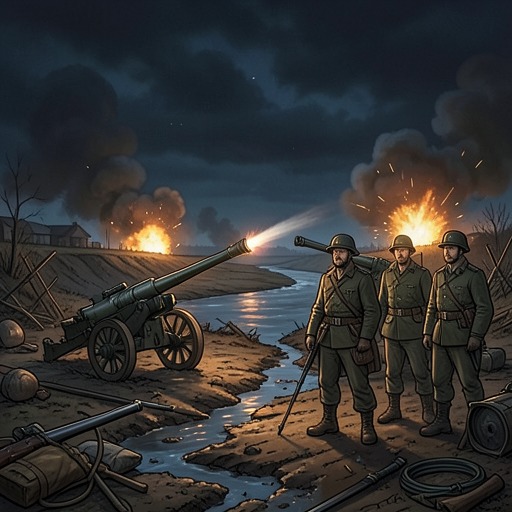
The action takes place where the Cherna flows into the Vardar, in a small triangle of land that Vasili recognizes as a poor place to make a stand, even for a single night. The Bulgarian front has already been retreating for three weeks. Five Krupp 77 mm howitzers face south toward Greece and two French divisions somewhere beyond the horizon; artillery shells are stacked beside the emplacement, and the river runs close enough that spent casings can be thrown onto a growing pile by its bank.
The Flood During the Bombardment
As the guns fire in repeated salvos, Vasili and the handlers pass heavy rounds to the loaders and clear the hot casings. In the storm, he hears one casing splash into the water and looks back. Lightning reveals that the river has risen from a shallow current into a raging torrent, its brown, silty water moving between the banks. For a moment Vasili is so absorbed by the change that a loader has to call him back to the work.
Tactical Consequences
The flood makes retreat impossible just as the French infantry approach. The artillery’s elevation climbs from fifty degrees to seventy-five, and the shells land ever closer to the Bulgarian position; even at their maximum elevation, they fall only about three hundred yards away. Captain Hoxa continues directing the fire from between two guns, using binoculars and a riding crop to signal adjustments. The river’s rise therefore does more than transform the landscape: it removes the possibility of escape while the guns’ limits bring the fighting closer.
Narrative Significance
The Cherna’s changing level marks the narrowing of the soldiers’ options. Its transformation is noticed in the brief interval between salvos, then absorbed back into the firing routine, until the higher water makes the danger unmistakable. The river also frames Vasili’s view of Captain Hoxa at the guns: with retreat cut off and the shells falling near, the landscape and bombardment converge in the scene Vasili watches in exacting detail.